Qwen vs Gemini vs OpenAI: Cheapest AI Stack in OpenRouter
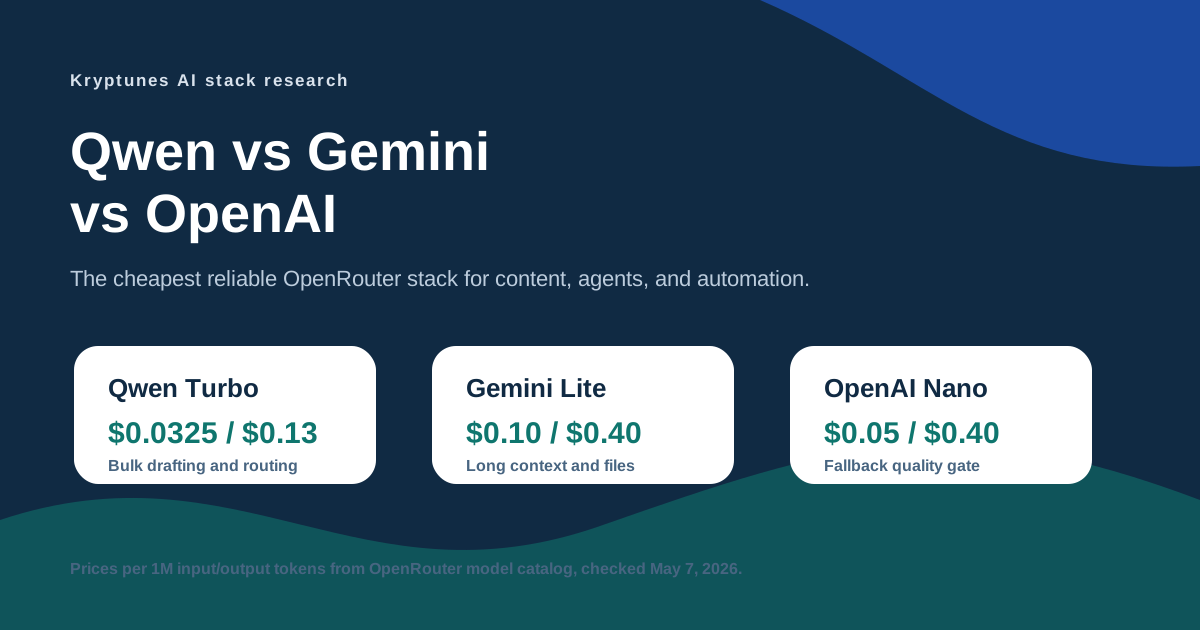
Qwen vs Gemini vs OpenAI: Cheapest AI Stack in OpenRouter
OpenRouter is useful because it lets a small team test many frontier and budget models behind one API key. But the real savings do not come from picking one cheap model and hoping it can do everything. The real savings come from routing: send simple work to the cheapest reliable model, send long-context work to a model built for large files, and reserve OpenAI for final checks or high-risk answers.
The practical answer for May 2026 is simple: use Qwen for high-volume drafting and routing, Gemini Flash Lite for long-context and multimodal work, and OpenAI Nano models as a quality gate. That stack gives a solo operator, content team, or small automation shop a low-cost model mix without locking everything into one provider.
Advertisement
Quick Verdict
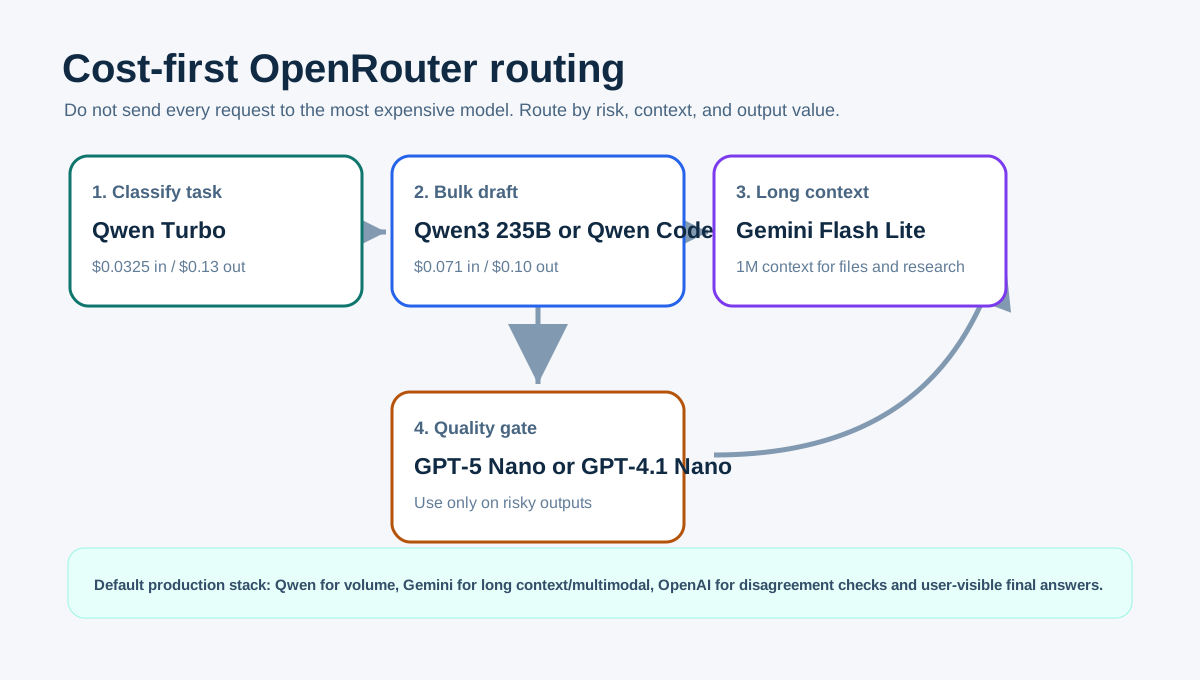
The cheapest reliable OpenRouter stack is not "all Qwen" or "all OpenAI." It is:
| Job | Recommended model on OpenRouter | Why |
|---|---|---|
| Bulk drafting, summarizing, classification | qwen/qwen-turbo | Very low token price and good enough for simple text work. |
| Cheap stronger reasoning pass | qwen/qwen3-235b-a22b-2507 | Low output price for a larger Qwen model. |
| Coding-focused middle layer | qwen/qwen3-coder-30b-a3b-instruct | Better fit for code tasks while staying inexpensive. |
| Long context, PDFs, files, multimodal input | google/gemini-2.5-flash-liteorgoogle/gemini-2.0-flash-lite-001 | Large context window and multimodal support. |
| Final answer check or risky user-visible output | openai/gpt-5-nanooropenai/gpt-4.1-nano | Cheap OpenAI fallback when quality, structured output, or consistency matters. |
If you are building a blog, research assistant, AI agent, or automation pipeline, this is the rule: Qwen first, Gemini when the context gets large, OpenAI when the answer is important enough to pay for a second opinion.
Live Rate Card Snapshot
Prices below are from the OpenRouter model catalog checked on May 7, 2026. They are listed per 1 million input tokens and 1 million output tokens. OpenRouter states that input and output tokens are billed per model at posted rates, and failed fallback attempts are not billed when routing/fallback is enabled.
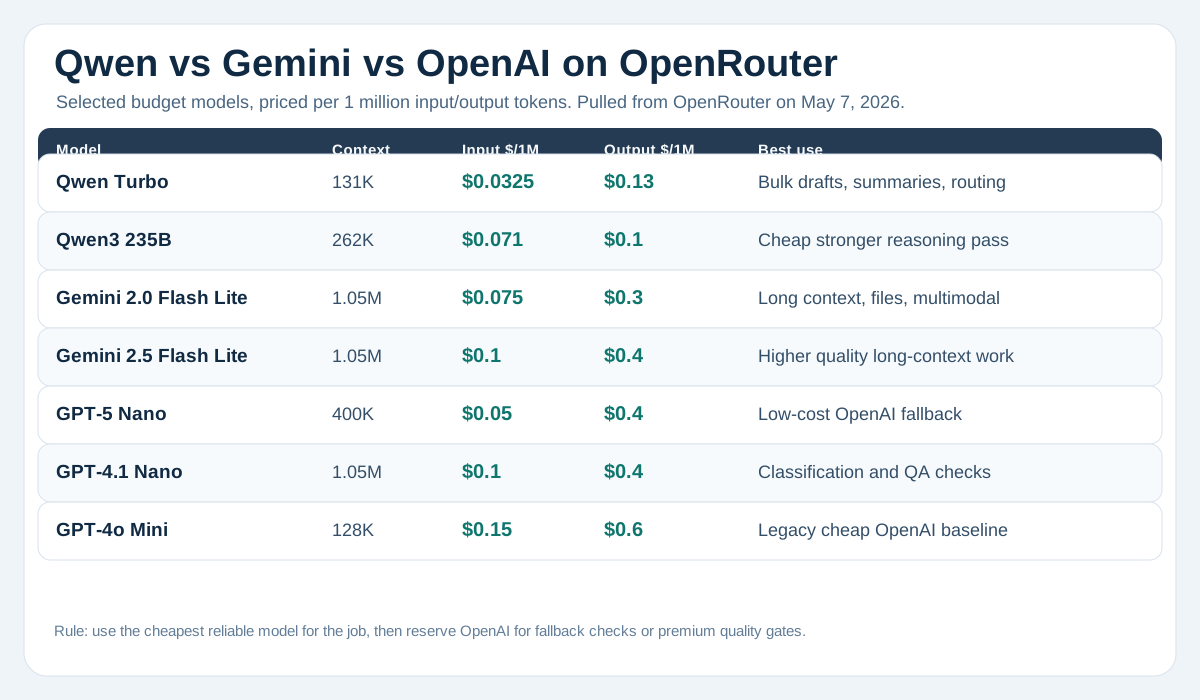
| Provider | Model | Context | Input / 1M | Output / 1M | Best use |
|---|---|---|---|---|---|
| Qwen | qwen/qwen-turbo | 131K | $0.0325 | $0.13 | Bulk drafting, summaries, intent routing |
| Qwen | qwen/qwen3-235b-a22b-2507 | 262K | $0.071 | $0.10 | Cheap stronger reasoning pass |
| Qwen | qwen/qwen3-coder-30b-a3b-instruct | 160K | $0.07 | $0.27 | Coding, refactors, workflow JSON |
| Gemini | google/gemini-2.0-flash-lite-001 | 1.05M | $0.075 | $0.30 | Long-context work at low cost |
| Gemini | google/gemini-2.5-flash-lite | 1.05M | $0.10 | $0.40 | Long context, files, multimodal input |
| OpenAI | openai/gpt-5-nano | 400K | $0.05 | $0.40 | Cheap OpenAI fallback |
| OpenAI | openai/gpt-4.1-nano | 1.05M | $0.10 | $0.40 | Classification, QA checks, structured outputs |
| OpenAI | openai/gpt-4o-mini | 128K | $0.15 | $0.60 | Legacy cheap OpenAI baseline |
The surprising number is Qwen3 235B: on this snapshot it is not the cheapest input model, but its output price is unusually low for a larger model. That matters because many content and coding workflows are output-heavy. If your automation asks for long reports, JSON, scripts, or article drafts, output price can dominate the monthly bill.
Recommended Stack
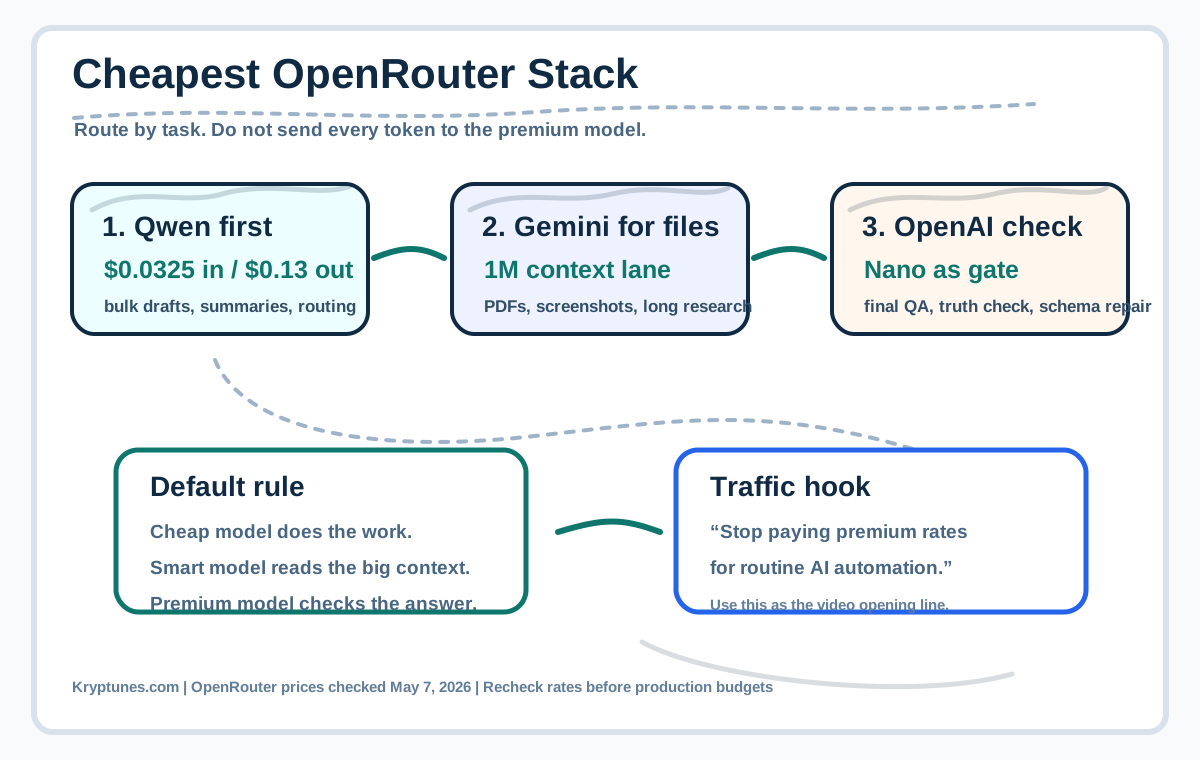
1. Use Qwen Turbo as the default cheap worker
Qwen Turbo is the right first stop for simple work:
- Rewrite a paragraph.
- Summarize notes.
- Classify a request.
- Generate first-draft outlines.
- Extract simple fields into JSON.
- Create social post variants.
At roughly $0.0325 per 1M input tokens and $0.13 per 1M output tokens on the checked OpenRouter snapshot, it is cheap enough to run frequently. Do not use it as the final judge for every high-risk output. Use it as the worker that handles volume.
2. Use Qwen3 235B or Qwen Coder when the task gets harder
For cheap reasoning and code tasks, Qwen has two useful lanes:
qwen/qwen3-235b-a22b-2507for stronger reasoning or second-pass editing.qwen/qwen3-coder-30b-a3b-instructfor code, n8n workflow JSON, scripts, and structured automation changes.
This gives the stack a low-cost middle layer before jumping to a premium model. The goal is not to pretend Qwen beats every frontier model. The goal is to avoid paying premium-model rates for routine work.
3. Use Gemini Flash Lite for long context and multimodal work
Gemini Flash Lite is the stack's long-context workhorse. Google positions Gemini 3.1 Flash-Lite as a cost-efficient model for high-volume agentic tasks, translation, and simple data processing. On OpenRouter, the Gemini Flash Lite family is useful when the task includes:
- Long PDFs.
- Multiple source articles.
- CSV or spreadsheet-like extracts.
- Screenshots, images, audio, or video input.
- Large website crawls.
- Research synthesis where the prompt itself is huge.
For a content pipeline, Gemini should handle "read all the context and find the important bits." Qwen can then draft and compress the result. OpenAI can check the final answer.
4. Use OpenAI Nano models as a quality gate
OpenAI should not be the first model for every cheap automation request. It should be the final model when the answer matters.
Use OpenAI Nano models for:
- Final title and meta description checks.
- "Does this article make a false claim?" review.
- JSON schema validation and repair.
- User-visible final response polish.
- Disagreement checks when Qwen and Gemini produce different answers.
This keeps OpenAI in the stack without letting it own the full bill.
Monthly Cost Scenarios
The blended stack below assumes 55% Qwen Turbo, 20% Qwen3 235B, 15% Gemini Flash Lite, and 10% GPT-5 Nano. It is a practical mix for a blog and automation operator: most work goes to Qwen, long context goes to Gemini, and a small slice goes to OpenAI.
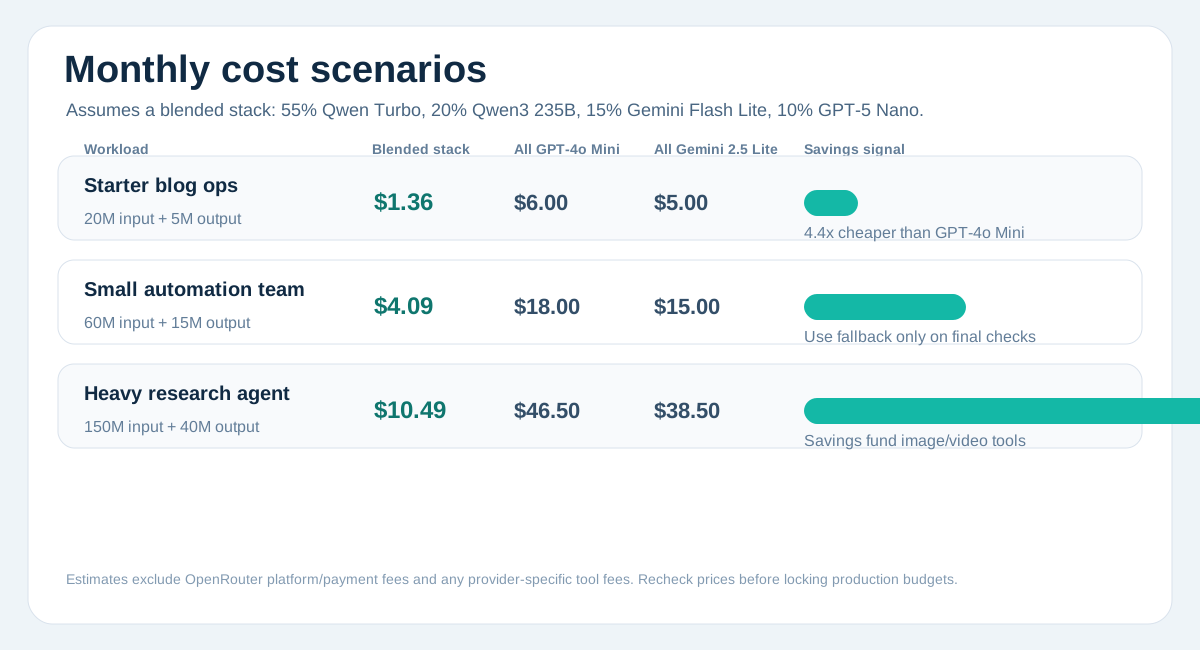
| Monthly workload | Blended Qwen/Gemini/OpenAI stack | All GPT-4o Mini | All Gemini 2.5 Flash Lite |
|---|---|---|---|
| 20M input + 5M output | ~$1.36 | ~$6.00 | ~$5.00 |
| 60M input + 15M output | ~$4.09 | ~$18.00 | ~$15.00 |
| 150M input + 40M output | ~$10.49 | ~$46.50 | ~$38.50 |
These are token-only estimates. They exclude OpenRouter platform/payment fees, provider tool fees, web search fees, image generation, and any paid hosting. Still, the signal is strong: the biggest savings come from not sending routine work to the same model used for final reasoning.
Best Stack by Use Case
For a blog and video pipeline
Use this for topic research, blog drafts, and later YouTube script creation:
| Stage | Model |
|---|---|
| Research clustering | Gemini Flash Lite |
| Outline and first draft | Qwen Turbo |
| Technical detail pass | Qwen3 235B or Qwen Coder |
| Final article check | GPT-5 Nano or GPT-4.1 Nano |
| Social captions | Qwen Turbo |
| Video script polish | Gemini Flash Lite or GPT-5 Nano |
This is the best fit for Kryptunes-style content because the weekend video can reuse the same article structure: hook, rate table, stack diagram, cost scenario, recommended path.
For AI agents
AI agents can burn money because they loop. The model stack should make looping cheap:
| Agent step | Model |
|---|---|
| Decide next action | Qwen Turbo |
| Read a large document | Gemini Flash Lite |
| Write code or config | Qwen Coder |
| Validate final output | OpenAI Nano |
| Retry after failure | Cheaper Qwen model first, not premium fallback first |
Add budget caps. Add per-task token logging. Add automatic fallback only when the first model fails validation.
For coding workflows
Use Qwen Coder for cheap first-pass implementation, then use OpenAI only for review or final bug-risk checks. Gemini is useful when the codebase context is huge, but it should not be the default if the task is a small patch.
What Not To Do
Do not route every request to the newest frontier model. That is how a cheap prototype becomes an expensive habit.
Do not rely only on free models for production. OpenRouter has free models, but the free plan has request limits and free-provider availability can change. Free is good for testing, not for a business workflow that needs predictable output.
Do not compare only input price. Long article drafts, code generation, and JSON generation can be output-heavy. A model with cheap input but expensive output can still cost more than expected.
Do not skip logging. Track model, input tokens, output tokens, estimated cost, task type, and whether the answer passed validation. Without logs, you will guess where the money went.
Final Recommendation
For most small teams, solo founders, and content operators, start with this OpenRouter stack:
qwen/qwen-turboas the default worker.qwen/qwen3-235b-a22b-2507for stronger cheap reasoning.qwen/qwen3-coder-30b-a3b-instructfor code and workflow automation.google/gemini-2.5-flash-litefor long context and multimodal input.openai/gpt-5-nanooropenai/gpt-4.1-nanofor final checks.
That stack is cheap enough for daily use, flexible enough for real workflows, and safer than betting everything on one provider. The winning move is routing, not loyalty.
Sources
Advertisement